01 / Write
Put your reasoning into the model.
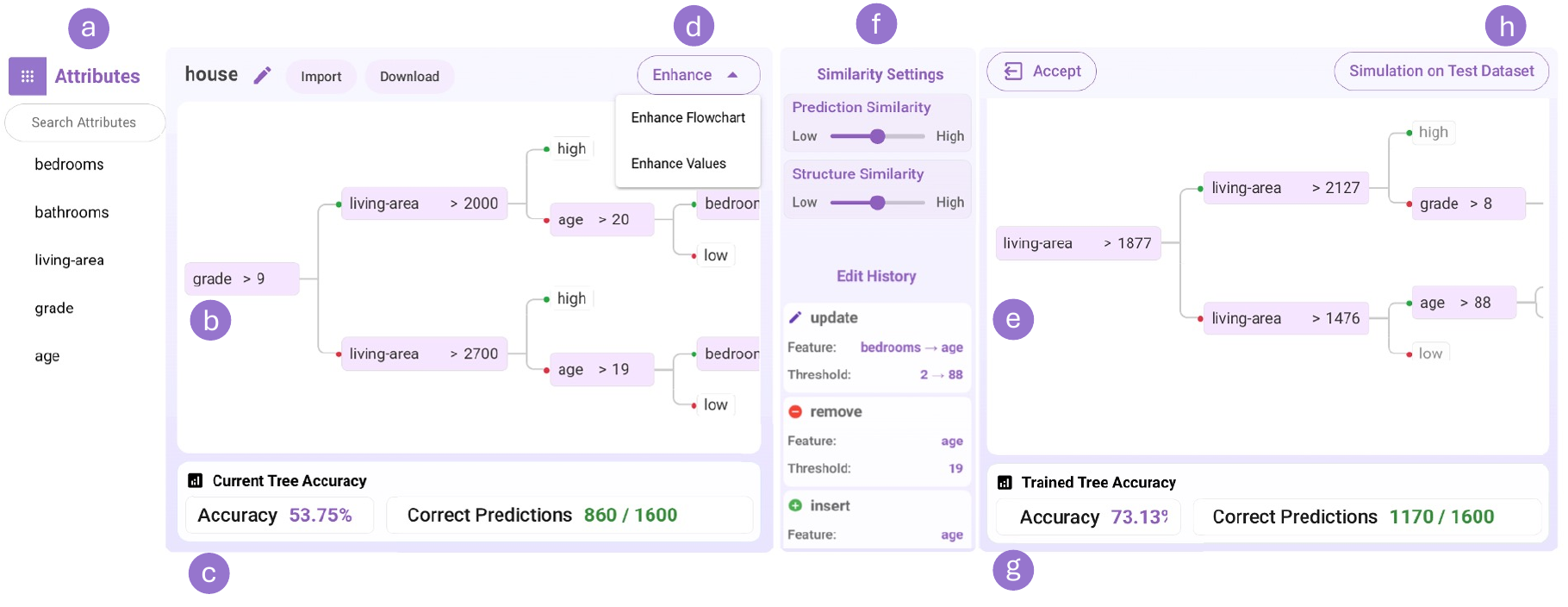
The user’s tree starts with grade > 9, then checks living area. Following the upper path, a house with living area > 2000 receives a high-price prediction.
These are editable rules on familiar attributes. CoExplain parses the written tree into a neural network, so the rules guide the model’s predictions.
What you controlAttributes, thresholds, and branches
02 / Enhance
Choose how much help you need.
Enhance Values refines numeric thresholds while keeping the tree’s structure. Enhance Flowchart can also reorganize the rules, adding or rearranging decision nodes.
Someone confident in the logic can ask for narrower adjustments; someone reconsidering the logic can allow structural changes.
Two kinds of assistanceRefine the numbers · Rework the structure
03 / Constrain
Keep the proposal close to your intent.
Prediction Similarity encourages the enhanced model to preserve the current tree’s predictions. Structure Similarity encourages it to retain the current arrangement of rules.
The edit history records updates, insertions, and removals. People can inspect what changed before accepting a proposal.
What the constraints doBalance learning from data with preserving rules
04 / Compare
Better performance still needs your judgment.
The proposed tree begins with living area, while the original begins with grade. Side-by-side rules and accuracy indicators make that change visible.
Users can accept the proposal or selectively incorporate parts they agree with. A separate simulation tests the rules on a test dataset.
What remains a human decisionWhich changes to accept